Tuesday, September 22, 2009

Why Rock Band trounces Guitar Hero

I can still remember, way back in 2005, the day I first heard about Guitar Hero. Specifically, it was from this Penny Arcade strip. "A music game that you play with a guitar-shaped controller? Sounds... dumb," I thought. This, coming from a guy who has spent countless hours and quarters on Dance Dance Revolution. But still, the idea of pressing buttons in time to music, whether it be on a guitar-shaped controller, or a regular controller, didn't really appeal to me. Then, my roommate bought it and I actually tried it out.

I immediately fell in love. The illusion sucked me in. It was air guitar, yet somehow so much more satisfying. From that day until today, Guitar Hero and its sequels and spin-offs have probably been the biggest portion of my gaming diet. Which is why it pains me to see the soulless husk that is the Guitar Hero franchise today.

The trouble started after the release of the superb Guitar Hero II. Harmonix, the original game developer, was purchased by MTV Networks, while RedOctane, who made the guitar controllers, was purchased by Activision. As a result, a schism happened. Activision would continue to publish the Guitar Hero franchise (handing development duties off to Neversoft), while Harmonix and MTV would develop a new music game.

I originally didn't think much about the split. Corporate buyouts happen all the time, right? But then I played the first Activision/Neversoft title, Guitar Hero III: Legends of Rock. Oh dear Lord. The problems were apparent right away. Instead of the usual "Play through an increasingly difficult list of rock songs" paradigm that defined the series up until that point, Guitar Hero III introduced "boss battles." Essentially, it would be you, the player, against a boss character, which was either Tom Morello or Slash. You would both play a song and attempt to make each other fail by using different "attacks." You could break the opponent's string, force him to use the whammy bar before he could play again, turn every note into a power chord, and so on.

On paper, it doesn't sound like a bad idea. In actual execution, it's terrible. It goes against practically everything that Guitar Hero was about up to that point, i.e. playing songs and having fun. No one plays a Guitar Hero game for the express purpose of forcing the other guy to fail by making him jam the whammy bar or play in Lefty mode or whatever. It was a shitty idea, it should never have been implemented, and Guitar Hero has basically never recovered from that blunder since Activision and Neversoft have been in charge of it.

Harmonix, meanwhile, was working on their next game, Rock Band. It took the basic Guitar Hero concept, and added drums and vocals for a full band experience. It appealed to me, but I initially couldn't justify the investment ($169.99 for the game and instruments). That changed after E3 of this year, where I finally got to try Rock Band 2 for the first time.

The awesome feeling I had from the very first time I played Guitar Hero came flashing back to me. This was it. This was the best music game. It combined a realistic music simulator with a killer multiplayer experience. It really did feel like playing in a band.

Activision and Neversoft, who know a good thing when they see it, did the only ethical thing: They blatantly copied Harmonix and came out with "Guitar Hero: World Tour," which also added drums and vocals. GameInformer even proclaimed that Neversoft was "changing music games forever."


Keep in mind this was after Rock Band was already on the market. So how exactly was Neversoft changing music games? By introducing plagiarism, I suppose.

Lack of originality aside, I've spent ample time playing both Rock Band 2 and Guitar Hero: World Tour and I can honestly say that Rock Band is a better game in pretty much every way.

Even if we put aside each game's song selection (which you will like or dislike solely based on personal taste anyway), Rock Band is clearly geared towards a fun, multiplayer experience. There's a wide range in difficulty for every instrument, and a good mix of popular and obscure songs. Harmonix was even the first to introduce No Fail mode, for people who want to challenge themselves on higher difficulties without the worry of losing, or people like myself who couldn't sing to save their lives but don't want to drag down everyone else in the band.

Guitar Hero, on the other hand, is all about pushing you towards higher and higher difficulties, with less focus on a coherent, balanced song selection. Why else would GH: World Tour include songs that are sung in Spanish? It also includes Joe Satriani's "Satch Boogie", a great song, but one without vocals entirely. So the singer gets to sit out just so the guitarist can challenge himself to one of the hardest note charts in the game.

Not to mention, it's still apparent just how much Guitar Hero and Rock Band copy off each other. Both games still assign a number of stars based on your performance on each song (5 stars being the best), and both still use the "Star Power" feature, which lets you stay alive during challenging parts of the song.

The big deciding factor for me, however, was in how both franchises incorporate drums. In Guitar Hero, the drum set consists of a snare, two tom-toms, and two cymbals (arranged from left to right as snare, cymbal, tom, cymbal, tom). Rock Band drums have four pads arranged like a cymbal-less set. I originally thought the Guitar Hero set would be superior, just by virtue of the fact that it has an extra tom. After playing both sets, though, I see the genius behind Rock Band's design. Even though it looks like there's only four "drums," each pad changes from tom to cymbal as the song dictates. So if the drums call for a beat being played on the ride cymbal, you'll hit the green pad for the cymbal and the red pad for the snare, using the yellow or blue pads for crash cymbals or even toms. Then, if the same song requires a long drum fill using 3 toms, the green pad will now function as a tom. If it sounds confusing, just watch this.

Guitar Hero drums, because of the way they're designed, are stuck in their respective roles, which can be confusing when trying to read the different colored notes scrolling toward you. Quick, is that note a cymbal or a tom? Ah, too late, you already missed it.

But if you ever needed rock solid proof of who puts more tender loving care into their games, the latest titles from each franchise are it: The Beatles: Rock Band vs. Guitar Hero 5. As Dennis Farrell of Something Awful put it, Guitar Hero 5 "[f]eatures just as many playable dead dudes as the newest Rock Band, but manages to do so in a much creepier fashion." He's referring, of course, to Johnny Cash and Kurt Cobain. So why is it creepy that Kurt Cobain is in Guitar Hero, other than the fact that it's the sort of thing he would have resented with every fiber of his being? Well...


Yeah, that's why. One can only guess that Kurt Cobain did something so monstrously vile to Neversoft when he was alive that they wanted to smear his image in the worst way possible. Seeing Kurt say "Yeeeeeeaaah, boooooiiii!!!" with Flavor Flav's voice is about the most fucked up thing I've seen in a videogame. And I've seen a little pink fluffy animal get crucified alongside a bunch of giant robots.

The Beatles: Rock Band, however, is the ultimate love letter to the Beatles and their legacy. It'd be hard to imagine George Harrison and John Lennon getting offended by such a loving tribute:


The presentation, the music, everything about The Beatles: Rock Band is stellar. I'm tempted to call it the best music rhythm game of all time.

If I haven't convinced you by now that Rock Band is superior, consider what the future holds: Rock Band Network. In a nutshell, this means that record labels will be able to produce their own Rock Band tracks. This also means that you (yes, you) will be able to make your own Rock Band tracks. And sell them. For money.

To me, preferring Rock Band over Guitar Hero is a much more meaningful decision than, say, choosing Coke over Pepsi. I see it as the difference between The Day the Earth Stood Still and "The Day the Earth Stopped". One is an original, classic work with something meaningful to contribute to the artform. The other is a quick cash-in with no originality to speak of. I've made my choice. I'm hoping you'll make the right choice as well.

(Note: I will issue a full retraction of this blog post and pledge my undying love to Guitar Hero forever if Activision ever makes "Guitar Hero: Frank Zappa.")
Monday, August 24, 2009

Games are no longer frustrating.

I know, it's been a long time since I've updated. It's been so long, in fact, that the last post of substance that I wrote, "Is every game frustrating?" has been rendered obsolete. I was checking out the AV Club's review of Shadow Complex, when I noticed that the little blurbs at the end of the reviews, including the bemoaned "Frustration sets in when" are now gone from all their recent game reviews. Kudos to you, AV Club, for giving games the same credibility as other types of media.

Longer updates are coming, I promise. For now, read my belly-achin' about Chronicles of Riddick: Assault on Dark Athena over at GamersInfo.net.

Tuesday, June 2, 2009

I'm at E3 this week.

That magical time known as the Electronic Entertainment Expo is at the Los Angeles Convention Center this week. I'm on assignment for GamersInfo.net, so check out that site in the coming days for my coverage of the random goings-on. I'll be looking at the latest games from Konami, Capcom, Atlus and many others. Go check it out.

Thursday, May 28, 2009

Is every game frustrating?

Anyone who knows me knows how much I love The Onion, America's finest news source. However, if you twist my arm, I'll admit that I love its sister publication The A.V. Club even more. Essentially The Onion's Arts & Entertainment section, The A.V. Club has reviews, features and articles about film, music and TV with the same witty, sardonic sense of humor of The Onion.

A few years ago, The A.V. Club started running videogame reviews. When this happened, I was elated. Who gives a fuck if Roger Ebert doesn't recognize that games are art? The A.V. Club is writing about games with the same insight as film, music and books. For all I knew, the Louvre could have added a videogame wing.

But it recently occurred to me that there's something odd with the way the A.V. Club does its game reviews. Each review is broken down into sections. First there's the review proper, and then short one- or two-sentence blurbs with the headers Beyond the game, Worth playing for, Final judgment, and finally, the one I take umbrage with: Frustration sets in when.

Now far be it from me to say I've never played a game that frustrated the hell out of me. But that phrase, "Frustration sets in when," appears in every game review that The A.V. Club runs, from mainstream blockbuster titles to under-the-radar indie games. For the recently-released Punch-Out!! it's when "Trainer Doc spits out another rote motivational entreaty instead of offering a hint you can actually use." For the intuitive browser game Today I Die, Gus Mastrapa explains, "Those who think too long about the financial limitations that prevent this kind of experimentation from sneaking into larger, longer, and more expensive games may be inspired to go looking for a rock, a rope, and a deep lake."

By incorporating the phrase into every game, regardless of genre, platform or overall quality, it's like the A.V. Club is assuming a priori that each and every game must have something frustrating about it, and the writer's obligation is to point it out. I humbly disagree.

I could point out games I've played that never frustrated me, but really, the whole experience is entirely subjective. But then again, that's the entire point. Everyone experiences games differently. One person might find a game to be entirely frustrating, while another person could breeze through it. By having that phrase form part of their review format, The A.V. Club is enforcing an unfair, and quite frankly false, standard.

Overall, The A.V. Club's game reviews are among the best out there. And having them alongside reviews of current movies, music and books just reinforces the point that games are on the same playing field as mainstream entertainment. But no other reviews on The A.V. Club suffer from this unfair standard. You won't see every film review pointing out the boring parts, and not every CD review mentions tracks that are worth skipping. So why the unfair treatment for games?

Saturday, May 23, 2009

Unfair Comparisons, Vol. I

ON ROMANCE

Film:


Games:


ON LOSING A LOVED ONE

Film:


Games:


ON ABUSIVE MEN

Film:


Games:

Thursday, May 14, 2009

What is it REALLY about?

I'm far from the only person who thinks that, in order for games to progress as an art form, they have to start telling better stories. The technology will always be improving -- that's a given. But it's a less safe bet that we're going to get better stories in the future. I'm optimistic, however, as I've gotten to know more and more people in the game design community who recognize the same flaws that I do as a player, and are actively working to remedy them.

(Note: For this post, I'm only concerned with story-driven games. Sports games, puzzle games, etc. are obviously exempt.)

The biggest problem with stories in games, as I see it, is that they are content to be about what they're about on the surface, without any sort of deeper meaning or significance to them. For example, the most recent story-driven game I've played is Resident Evil 5. It's a great game, fun as all hell, but the story is all there in the synopsis: you, the hero, overcome obstacles (and lots of zombies) to stop a nefarious plot to conquer the world. And that's it. Good conquers evil, the end. Sub in almost any major title you can think of. Contra, Gears of War, Ninja Gaiden, the list could go on forever. The thing all these games have in common is that they feature a hero (or heroes, or heroine) conquering evil, vanquishing bad guys, saving the world...and that's all.

I don't mean "and that's all" as if saving the world is an insignificant task. Rather, from a literary perspective, it's rather shallow.

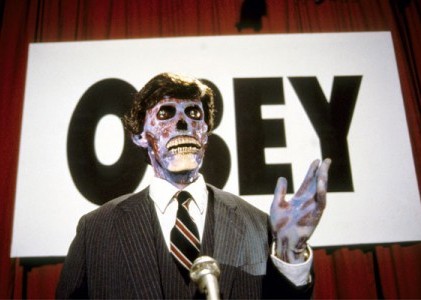
Compare this to something like the film They Live. It, too, is about a hero battling monsters and eventually saving the world. But by reading between the liens, you can easily find a subtext about anti-Reagan consumerism that was so fervent in the 1980s. Think about it: Is it any coincidence that the protagonist is a working class hero, fighting "aliens" who all happen to be in the upper crust of society?


Now, I'm not suggesting that games now need to have hidden agendas or subversive messages. I merely used They Live because it encapsulates my point: that even though it's about saving the world, it's also about more than that. We take away from the film something more than, "Boy, I sure am glad the good guys won."

To use a videogame example, Portal has a hero that traverses obstacles and conquers evil, but there's clearly a deeper level of story going on. One writer went so far as to suggest that Portal was a feminist deconstruction of the first-person shooter genre.Whether the feminist subtext was intended by the game designers or not, what's important is that there was distinct substance to the game.

It occurred to me that, when I talk about wanting people to take games more seriously, this is really the best way to do it. The most common criticisms I hear essentially boil down to, "You're just killing a bunch of guys." I could throw out counter-examples (Portal, Braid, etc.) but this doesn't address the heart of the criticism, because they're right! In RE5, a state-of-the-art game, you're just killing a bunch of guys! From a story perspective, there's nothing more to it!

But obviously, this hasn't stopped it from being popular or successful. People love killing a bunch of guys. Hell, even I do. If RE5 had a deep, complex story, with dynamic characters and a pointed message about society, would it be any more successful? Probably not, but at least people wouldn't be able to dismiss it as a game where you simply "kill a bunch of guys."

So I repeat my assertion that, in order for games to progress as an art form, in order for games to be taken more seriously, they need real stories. We need less "Valiant hero overcomes obstacles, vanquishes evil and saves the world," and more "Valiant hero grows, matures, and ends up a better person for having had the experience." Perhaps in Resident Evil 6.

Tuesday, March 31, 2009

How World War II Became the Mushroom Kingdom

Last week was Game Developers Conference in San Francisco, and while there are a number of things I could write about, I feel like other writers out there have covered the major announcements quite thoroughly. Instead, I'd like to focus on something that probably no one else noticed.

In the Career Pavilion, Activision had a huge booth set up with Guitar Hero: World Tour front and center on a big stage, so anyone could show off their chops in front of the rest of the attendees. But meanwhile, tucked off to the side they had an Xbox 360 set up with the latest Call of Duty game, subtitled World at War, which is set during World War II. In case anyone isn't familiar, Call of Duty is a first-person shooter that focuses on intense realism.

I played the game on two different occasions, and each time was a different scenario. In the first scenario, I was a Russian soldier fighting the Third Reich in a gritty urban setting in Eastern Europe. In the other, I was an U.S. soldier fighting the Imperial Japanese Army in the Pacific theater.

What struck me most is how they designed the game to make fighting Germans and Japanese to feel like two distinct scenarios. Fighting the German army involved sneaking through bombed-out buildings and sewers, so I had to be sneaky. By contrast, the fight against the Japanese army took place outdoors, and felt more like a siege. My squad was attempting to take control of a strategic position, so the emphasis was on pushing forward as quick as possible.

Enemy tactics were also varied in the two scenarios, the biggest difference being that the Japanese army had banzai soldiers who would rush straight at you with their bayonets. If you don't kill them before they reach you, or press the melee attack button at just the right time to counter-attack, then you get stabbed and killed.

Now, from a purely design-oriented standpoint, all of this is great. Fighting Germany should feel different from fighting Japan. And the game is fun to play. It has just the right mix of action and challenge to be addictive without being frustrating.

However, the problem I had with the game was this: being about World War II, the events of this game are based on real people, who really lived and died. Many of us probably have living relatives who fought in WW2. What Activision has done is essentially to take those real-life armies and reduced them to green-shelled and red-shelled koopas.

While I was playing, I couldn't shake the feeling in the back of my mind that taking this intense real-life conflict and applying all the familiar tropes of a videogame to it somehow cheapened the reality that it was based on. How would a veteran like to know that all the training and battle experience he went through became reduced to, "Press the melee button when the Banzai soldier gets close"?

But I don't want to sound like I'm knocking the game itself. The game was fun as hell. I just felt like taking a worldwide conflict and slicing it up into "levels" that have their own "enemies" was a weird treatment of the event. Then again, I'm hard-pressed to come up with a better way that they could've done it. I don't know if there's a way to capture both the urge to kill Nazis with a sense of respect for those who lived and died during the conflict, or if fostering a sense of respect is something the game should try to accomplish in the first place.

But maybe this doesn't even matter in the long run. The game is fun to play, pure and simple. So should one even consider if the events of the past have been cheapened through recreation? I'll leave it for the game designers to decide for themselves.